
Whale & Dolphin Watching in Monaco: An Eco-Conscious Guide to the Pelagos Sanctuary
Just off the coast of Cap-d'Ail, the Mediterranean opens into one of the most extraordinary marine environments in Europe: the Pelagos Sanctuary, an 87,500 km² protected area shared between France, Italy and Monaco, and home to the largest concentration of cetaceans in the western Mediterranean. Fin whales, sperm whales, dolphins, pilot whales — all live and migrate through waters that begin, quite literally, at the bottom of the Villa Monaco driveway.
For guests staying at Villa Monaco, a half-day at sea in the Sanctuary is one of the most memorable, and least advertised, experiences on the Riviera. This is a guide to how to do it well — and to do it responsibly.

The Sanctuary
What the Pelagos Sanctuary Actually Is
The Pelagos Sanctuary for Mediterranean Marine Mammals was created by a landmark agreement signed in Rome on 25 November 1999 between France, Italy and the Principality of Monaco, and entered into force in February 2002. It was the first transboundary Marine Protected Area established anywhere in the world specifically to protect cetaceans — a Specially Protected Area of Mediterranean Importance (SPAMI) covering 87,500 km² of open sea and 2,022 km of coastline between the French Riviera, western Italy, the northern tip of Sardinia, and the whole of Corsica.
Monaco is not simply near the Sanctuary. The Principality sits at its heart, and the Fondation Prince Albert II de Monaco plays a leading international role in its ongoing protection and research programmes.
Eight species of cetaceans are regularly encountered within the Sanctuary:
Fin Whale
The second-largest whale species in the world, reaching over 20 metres. The Mediterranean fin whale population is a distinct, genetically isolated subpopulation.
Sperm Whale
The largest toothed predator on Earth, famous for its deep dives — over 2,000 metres in pursuit of squid — and for the distinctive tail-slap on the surface before descending.
Bottlenose Dolphin
Present year-round in the Sanctuary, curious, and often the species most likely to approach a boat and ride the wake.
Striped Dolphin
The most numerous cetacean in the Pelagos Sanctuary. Highly acrobatic; large pods are common in summer.
Common Dolphin
Once genuinely common in the Mediterranean, now categorised as endangered here. Every sighting matters.
Long-Finned Pilot Whale
A large member of the oceanic dolphin family, highly social, and often seen in tight, cohesive family pods.
Risso's Dolphin
Recognisable by its pale, heavily scarred body and blunt head. A deep-water specialist.
Cuvier's Beaked Whale
One of the deepest-diving mammals on Earth, holding the record at nearly 3,000 metres. Rare to see at the surface, but present.
Sea turtles, mobula rays, seabirds and — very occasionally — the exceptionally rare Mediterranean monk seal also share these waters.
Responsible Tourism
What an Ethical Whale-Watching Tour Looks Like
A whale-watching tour that operates well is essentially invisible to the animals: boats keep quiet, keep distance, and keep the sighting brief. The alternative — chasing pods, cutting engines abruptly, surrounding animals with multiple vessels — causes measurable stress and, over time, drives cetaceans away from the areas most valuable to them. Booking with a certified operator is not a luxury, but a genuine part of the conservation model.
Boats never chase or surround animals
Certified operators approach at low speed, parallel to the animals' direction of travel, and never from directly ahead or behind. Once cetaceans are in view, engines are dropped to idle. Sightings typically last no more than fifteen to twenty minutes before the boat withdraws.
"High Quality Whale-Watching®" label
The High Quality Whale-Watching® label, developed under the ACCOBAMS agreement (the intergovernmental body governing cetacean protection in the Mediterranean and Black Sea), certifies operators who have committed to the strictest observation practices. We recommend guests only book with certified operators.
Passenger numbers are limited
Reputable operators cap passenger numbers per vessel to ensure a genuine viewing experience and to reduce the environmental footprint of each trip. Private charter (see below) takes this to the natural conclusion.
A marine biologist as your guide
The best operators include a trained marine biologist on every tour — narrating behaviour in real time, identifying individuals by dorsal fin markings, and explaining the ecology of the Sanctuary. This transforms a good boat trip into a genuine field experience.
One rule that surprises first-time visitors is worth stating clearly: swimming with wild cetaceans is prohibited within the Pelagos Sanctuary. This is a legal restriction, not merely a recommendation — designed to prevent stress and behavioural disturbance to the animals. Reputable operators enforce it strictly.
The Experience
What to Expect on a Four-Hour Safari
A typical half-day tour departs from Port Hercule in Monaco, roughly a five-minute drive from Villa Monaco. Total time on the water is around four hours, structured as follows:
| Phase | Activity |
|---|---|
| Departure | Set off from Port Hercule, Monaco. Safety briefing, introduction to the crew and to the marine biologist on board. |
| First Hour | Cruise along the Riviera coast at moderate speed. Panoramic views of Cap-d'Ail, Monaco, Cap Martin and the Italian coast in the distance. |
| Mid-Tour | Enter the heart of the Pelagos Sanctuary, where cetacean sightings are most frequent. Engines drop, observation begins. |
| Highlights | Dolphin pods riding the wake, whales surfacing to breathe, and — in season — the occasional breaching fin whale. Real-time commentary from the marine biologist throughout. |
| Return | Refreshments on deck as the boat heads back to Monaco with the coast in golden afternoon light. |
Bring binoculars, a camera with a zoom lens, sun protection and a hat. A light jacket for the return leg — the sea breeze cools noticeably as afternoon shifts to evening.
A well-run whale-watching tour is essentially invisible to the animals: quiet approach, respectful distance, brief encounter, clean withdrawal.
The Season
When to Go — April to October
The Pelagos Sanctuary is active year-round, but the peak window for whale and dolphin watching runs from April through October. Different species peak at different points in that window:
| Month | What You Are Likely to See | Weather |
|---|---|---|
| April – June | Peak season for fin whales and large dolphin pods. Highest sighting probability of the year. | Mild and sunny · 18–22°C |
| July – August | Sperm whales and large striped-dolphin pods. Warmer seas, longer daylight, well-suited to families. | Warm · 22–28°C |
| Sept – Oct | Whales feeding intensively before migration. Fewer boats on the water; often dramatic surface behaviour. | Still warm · 20–25°C |
Early morning departures typically encounter the calmest seas and the best light for observation. Late afternoon departures can be spectacular for the return leg, with the Riviera coast glowing gold as you head back to port.
Private Charter
The Exclusive Half-Day Experience
For a genuinely private experience — no other passengers, flexible timing, and complete control of the itinerary — a private charter is the natural choice. The operator we most often recommend to Villa Monaco guests, Sustainable Whale Watching Monaco, offers a private half-day charter at a fixed rate:
Private charter for your group
- Morning departure (approx. 8:00–12:30) or afternoon (approx. 14:00–18:30)
- Up to 12 guests on board
- Marine biologist and full crew included
- Personalised itinerary within the Sanctuary
- Refreshments and light provisions on board
- 5% of the price is contributed to the protection of the Pelagos Sanctuary
The operator holds the High Quality Whale-Watching® certification and is a formal partner of the Fondation Prince Albert II de Monaco. Departures are from Port Hercule; Villa Monaco's concierge team handles the booking, the timing, and transfers directly from the villa gate.
Families
Whale & Dolphin Watching with Children
Few holiday experiences leave a stronger impression on children than a first sighting of a dolphin pod riding the boat's wake, or a whale surfacing metres from the hull. It is also one of the most naturally educational activities available on the Riviera — an introduction to marine biology, conservation and the fragility of ecosystems that no aquarium can rival.
Most operators welcome children of appropriate age (individual operators set their own minimums; check when booking). The boats used for Sanctuary tours are stable and comfortable, and crews are well-practised at making the experience enjoyable for younger passengers. For families particularly wanting flexibility — earlier or later departures, shorter breaks between observation windows, meals on board — private charter is worth the difference in cost.
Your Base
Combining the Adventure With a Stay at Villa Monaco
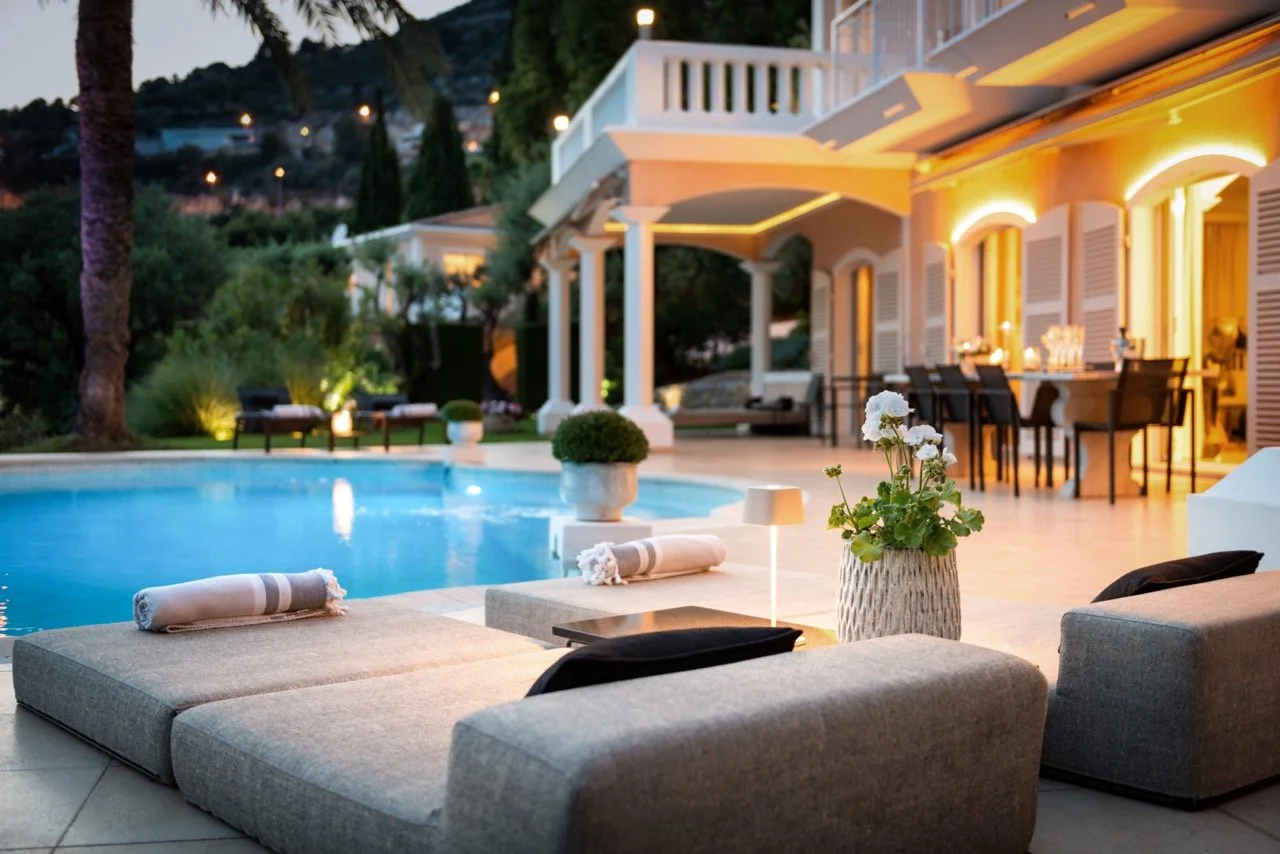
A morning on the water followed by an afternoon at the villa is, for many guests, one of the most complete days of a Riviera stay. Departure from Port Hercule is five minutes from the villa gate; return by mid-afternoon leaves time for a long lunch on the poolside terrace, a swim in the heated infinity pool, and a private-chef dinner as the light fades over the Mediterranean.
The villa's concierge team arranges the booking end-to-end — the operator selection, the departure time to match your rhythm, and the transfer to and from the port. Guests interested in the villa's broader commitment to sustainable Riviera experiences can read about the property's Golden Planet Award 2025 for Sustainable Lifestyle, awarded at the same ceremony as HSH Prince Albert II.
Practical Information
Booking, Prices, What's Included
Certified High Quality Whale-Watching®. Formal partner of the Fondation Prince Albert II de Monaco.
whalewatchingmonaco.com
Roughly 5 minutes by car from the Villa Monaco gate in Cap-d'Ail.
Includes marine biologist, crew, refreshments and 5% contribution to Pelagos Sanctuary protection.
Frequently Asked
Whale & Dolphin Watching in Monaco — FAQ
Is whale and dolphin watching safe for the animals?
Yes, when booked with a certified operator. Tours in the Pelagos Sanctuary that hold the High Quality Whale-Watching® certification follow strict guidelines: respectful distance, low approach speed, no chasing, no surrounding, brief encounters. Booking with a certified operator is the single most important thing a visitor can do to make the encounter responsible.
Can we swim with the dolphins or whales?
No. Swimming with wild cetaceans is prohibited within the Pelagos Sanctuary. This is a legal restriction, in place to protect the animals from behavioural disturbance. Reputable operators enforce it strictly.
What's the best time of day for a tour?
Morning departures typically encounter the calmest seas and the best observation conditions. Afternoon departures can be excellent for families and offer beautiful returning light along the Riviera coast.
What if we don't see any whales or dolphins?
Sightings are very frequent during peak season, but the animals are wild and nothing is guaranteed. Most reputable operators offer a discount or free rebooking policy if no cetaceans are spotted — confirm the specific terms with your operator when booking.
Is the activity suitable for pregnant women or guests with mobility issues?
The boats used for Sanctuary tours are generally stable and comfortable. Pregnant guests should consult their doctor before booking. For mobility considerations, private charter offers considerably more flexibility on boarding, seating and timing.
Can we bring food and drinks on board?
Most operators allow light snacks and non-alcoholic drinks. Avoid glass containers, and never throw anything overboard — even fully biodegradable items disrupt the marine environment.
Can I bring a drone for filming?
No. Drones cause measurable disturbance to cetaceans and are prohibited above the animals in the Sanctuary. Bring a camera with a zoom lens; a 200mm equivalent or longer produces excellent results without disturbing the wildlife.
How does the villa arrange the booking?
The Villa Monaco concierge team handles the operator booking, timing and port transfers as part of the standard concierge service. Guests wanting a private charter can also express specific preferences — morning or afternoon, group size, refreshment preferences — before arrival.