
Traveling the French Riviera in a Hot Summer — A Practical Guide for 2026
The summer of 2026 has, so far, been the hottest on European record. Since late May, temperatures have broken all-time records across more than a dozen countries — 44°C in southwestern France, 41.7°C in eastern Germany, red heat alerts as far north as the United Kingdom. Cities have closed schools, disrupted rail networks and, tragically, reported thousands of excess deaths. Anyone planning European travel this summer is now doing so with weather at the front of mind rather than the back.
This piece is a practical, honest guide to travelling well in a hot European summer — where the Mediterranean coast fits into that decision, why coastal heat is measurably different from inland or urban heat, and where a well-adapted private base can help. We will not pretend the Côte d'Azur is cool in July; it isn't. But it is differently hot, and — for travellers who have the flexibility to choose their setting — a shaded terrace above the sea, three minutes from the Monaco border, is a materially different experience from a 42°C afternoon on a Paris rooftop or a 45°C night in a Roman apartment without air-conditioning.
The Climate
Why Coastal Heat & Urban Heat Are Not the Same Thing
Meteorologists have said publicly through this heatwave what most Mediterranean locals have known through experience: the same 35°C headline number describes a very different day depending on where you are standing. The World Meteorological Organization pointed out that a regional temperature of 35°C can translate to 38 or even 40°C on a dense city street with no shade or green spaces — the "urban heat island effect." The health consequences also depend heavily on overnight temperatures: a day that reaches 38°C but drops to 18°C at night is much less taxing on the body than one that reaches 36°C and stays above 25°C through the night.
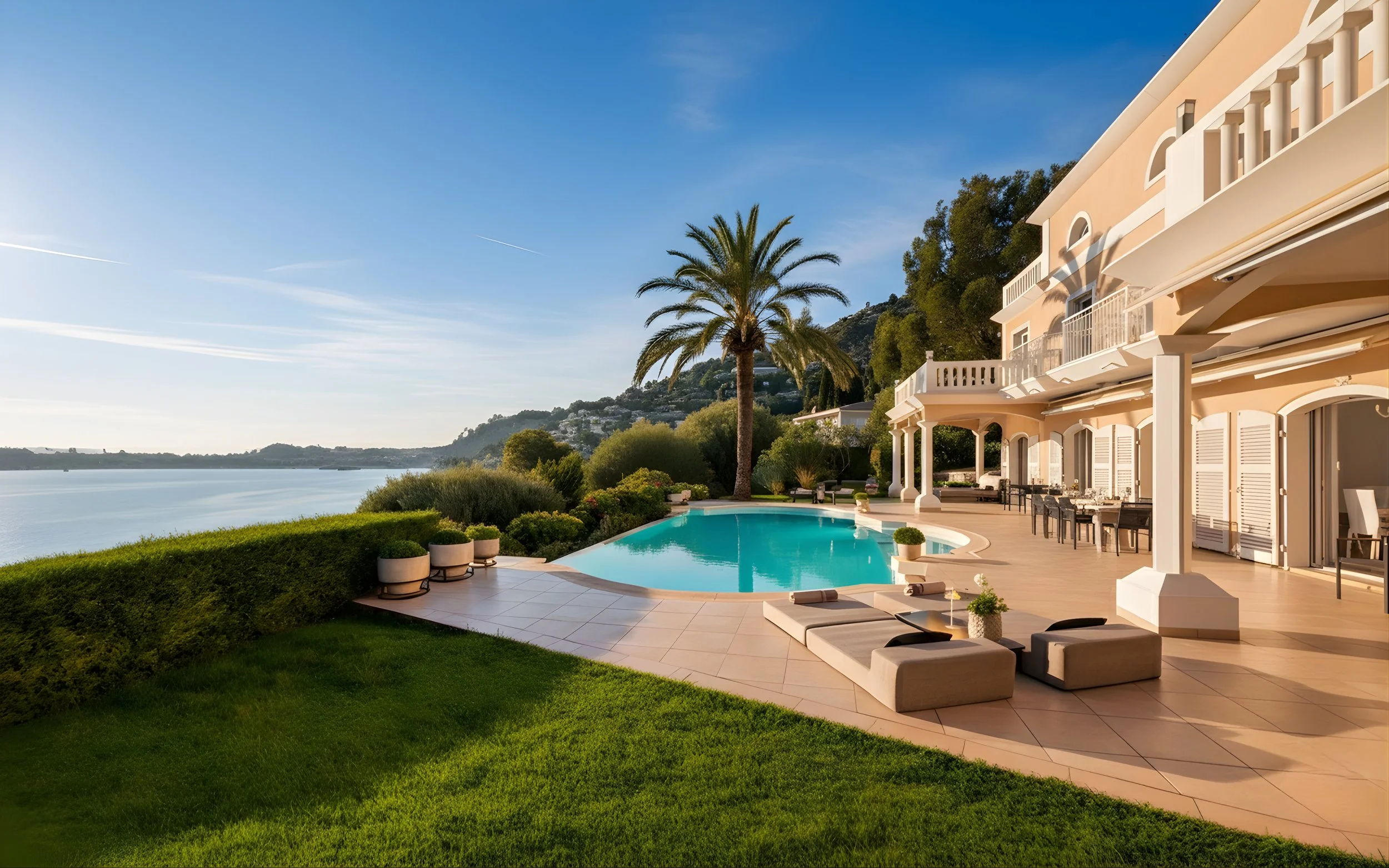
On the Côte d'Azur, three factors moderate summer heat in ways that inland European cities cannot replicate. First, the sea itself: the Mediterranean acts as an enormous thermal buffer, absorbing daytime heat and releasing it slowly, which measurably lowers coastal daytime peaks and — crucially — softens nighttime lows. Second, the topography: the Corniche and Cap-d'Ail rise steeply from the water, so the natural breeze from the sea has direct access to the residential areas above. Third, the built environment: villas along this coast are designed for summer — thick masonry walls, deep terraces, pergolas, shutters, gardens with mature Mediterranean trees for shade. These are not just aesthetic choices. They are heat management, evolved over centuries.
A day that reaches 38°C but drops to 18°C at night is much less taxing on the body than one that reaches 36°C and stays above 25°C through the night.
Practical Advice
Travelling the Riviera Well in a Hot Summer
Whether or not the villa is your base for this trip, the guidance below applies to any traveller planning a French Riviera stay in July or August 2026. It is drawn from local practice, not marketing copy.
The Villa
How Villa Monaco Is Adapted to a Hot Summer
The features below are not marketing bullet points — they are the specific reasons why Villa Monaco is a well-adapted base for a Riviera summer, especially in a year when heat is the primary variable. Each addresses one of the six practical points above.
Full air conditioning throughout
Every one of the six private suites is fully air-conditioned, as are the main reception rooms. This is not universally true even at the top of the Riviera rental market — many historic properties compromise on climate control for aesthetic reasons. The villa was renovated with genuinely modern systems.
Elevated position with sea breeze
The villa sits above Cap-d'Ail with an open aspect toward the Mediterranean. The prevailing summer breeze from the sea has direct access to the terraces and — with windows and shutters positioned correctly — cools the interior naturally through the evening and night.
Heated infinity pool, private grounds
A private pool that guests can use at any time of day, including the cooler morning and late-evening hours, removes the entire question of navigating crowded public beaches in peak heat. The pool is set within gardens designed with Mediterranean plantings that generate shade rather than heat.
Deep shaded terraces
Multiple covered outdoor spaces mean that meals, reading and family time can take place outside even during the hottest hours — the traditional Mediterranean solution to summer, executed properly. This changes the character of even the hottest days.
Concierge for early & late activities
The concierge team can arrange the small logistics that make hot-weather travel easier — private early-morning boat access, chauffeured transfers timed for cooler hours, restaurant reservations at venues with strong air conditioning, private beach club arrangements outside peak crowds.
Private chef on request
Perhaps the most underrated summer feature of all: on the very hottest days, the option to have a private chef prepare a light Mediterranean meal at the villa itself — removing any need to travel to a restaurant during afternoon heat peaks — is one of the meaningful comfort differences between a private villa stay and a hotel.
The 2026 heatwave is a genuine humanitarian event. France has recorded more than 2,000 excess deaths since June, and the health impact across the continent has been serious. We recognise that a piece about summer travel written in this context needs to acknowledge that reality plainly, rather than treat the heat as a marketing hook.
The practical points above are offered as useful travel guidance for anyone visiting the Riviera this summer — whether staying at the villa or not. If they are helpful, share them. The wider case for well-adapted coastal accommodation is a real one, and it applies regardless of where you eventually stay.
Availability
A Short Window Before the Next Booking
Villa Monaco has a short window of availability from now until 5 August 2026, when the next confirmed booking begins. For anyone reconsidering their summer plans in light of the current heat conditions — or simply reassessing where to spend the coming three or four weeks — the villa is available for direct enquiry through the owner. No agency intermediaries; discreet enquiries welcomed.
Six bedrooms, full air conditioning, heated infinity pool, private chef available on request, chauffeur and concierge included. Three minutes from the Monaco border. Eight minutes from Port Hercule for the Monaco summer fireworks on 25 July and 1 August. Enquire directly below.
Frequently Asked
Riviera Travel in a Hot Summer — FAQ
Is it too hot to travel to the French Riviera in summer 2026?
The Côte d'Azur has been affected by the same European heatwave as the rest of the continent, but coastal Mediterranean climates are typically 2–3°C cooler in the afternoon than nearby inland or urban locations, and materially cooler overnight because of the sea's thermal moderating effect. With appropriate accommodation (air conditioning, private outdoor space, elevated position with sea breeze), the Riviera remains a comfortable summer destination — arguably more so than Paris, Rome or Madrid in the same period.
What time of day is safest for outdoor activities?
Early morning (before 11am) and late afternoon (after 5pm) are the two clearly safer windows during a heatwave. The middle of the day — roughly 12pm to 4pm — should be reserved for shade, indoor spaces, water and rest. Local Riviera culture aligns with this instinctively; travellers on packed itineraries often do not, which is where most heat-related trouble begins.
Does Villa Monaco have air conditioning?
Yes — all six private suites and the main reception areas of the villa are fully air-conditioned. This is genuinely important in 2026: only around 20% of European homes have air conditioning, and many mid-range accommodations along the coast still do not offer full AC in every bedroom.
What makes coastal locations cooler than inland cities?
Three factors: the sea itself, which absorbs daytime heat and releases it slowly, moderating both daytime peaks and overnight lows; the sea breeze, which reaches elevated coastal residential areas throughout the day; and the traditional Mediterranean built environment (thick walls, shutters, pergolas, mature shade trees), which is designed for summer in a way that most inland European housing stock is not.
Are the Monaco fireworks still happening despite the heat?
Yes — the two Mairie de Monaco fireworks evenings on 25 July and 1 August 2026 are confirmed to proceed as planned. Full details in our Monaco summer fireworks guide. Evening events are of course the coolest part of the day and remain enjoyable through peak summer.
How should I plan restaurant bookings during a heatwave?
A useful pattern is lunch indoors at venues with strong air conditioning, and dinner outdoors on shaded terraces after the sun has dropped and temperatures have eased. Most of the Michelin-starred restaurants covered in our Michelin guide operate exactly on this rhythm through July and August, and their concierge and reservations teams will guide you accordingly.
Is there a short-notice availability at Villa Monaco this summer?
Yes — the villa is available from now until 5 August 2026, when the next confirmed booking begins. Direct enquiries through the owner are welcomed, without agency intermediaries.