
Art on the Côte d'Azur — A Complete Guide to the Riviera's Great Museums
For more than a century, the French Riviera has been Europe's modern-art capital. Drawn by its extraordinary Mediterranean light, mild climate, and a creative community that ran from Antibes to Menton, masters such as Pablo Picasso, Marc Chagall, Henri Matisse, Pierre-Auguste Renoir, Fernand Léger, Jean Cocteau and Yves Klein lived, worked and created some of the twentieth century's defining works along this stretch of coast. Their legacy survives today in one of the densest concentrations of world-class museums, artist homes, sacred chapels and sculpture gardens anywhere in Europe.
From Villa Monaco in Cap-d'Ail, almost every one of these landmarks is within a short, scenic drive — making the villa one of the rare luxury bases on the Côte d'Azur from which an entire art-focused holiday can be built. Owned by a passionate art collector who has hosted private exhibitions at the villa itself, it is also a property that genuinely lives this story rather than merely points to it.

I · The Masters
Where They Lived & Created — Nine Essential Visits
Below, the nine museums and artistic landmarks that, together, tell the story of modern art on the Côte d'Azur. Ordered geographically from west to east — from Vallauris near Cannes through Nice and the Vence hinterland to Menton on the Italian border — and matched to the numbered pins on the map further down this page.
Picasso spent nearly three decades on the Riviera. His final major political work — the monumental War and Peace murals — was painted across the walls of a 12th-century Romanesque chapel inside the Château de Vallauris. The museum also presents his ceramics produced in collaboration with the Madoura pottery, where Picasso made over 4,000 pieces during his years here.
musee-picasso-vallauris.frInaugurated in 1960 in the presence of Picasso, Braque and Chagall, the Léger museum is recognisable for its monumental mosaic façades — Léger's own designs, scaled to architecture. Inside, 450 paintings, drawings and ceramics trace fifty years of bold colour and geometric form. The Mediterranean garden of sculptures and the family workshops make this the most child-friendly of the Riviera's great museums.
musees-nationaux-alpesmaritimes.frFor the last eleven years of his life, Renoir lived at Les Collettes, a beautiful estate surrounded by centuries-old olive trees with views down to the Mediterranean. The house is preserved almost exactly as he left it — including his wheelchair-adapted studio, where he continued painting until his death despite severe arthritis. One of the most personal artist museums on the Riviera, and free entry for visitors under 26.
cagnes-tourisme.comWidely regarded as Europe's finest private modern-art foundation, the Maeght was created by gallerists Aimé and Marguerite Maeght with their close friends Miró, Giacometti, Braque and Chagall. Sert's modernist architecture is woven into the landscape — courtyards, terraces, fountains, mosaics — with the works seamlessly placed throughout. Plan three hours minimum; the on-site restaurant beside the Chagall mosaic is one of the loveliest lunch spots on the Riviera.
fondation-maeght.comMatisse himself called the Rosary Chapel his masterpiece. Designed in every detail — stained glass, tile walls, liturgical vestments, even the priest's robes — between 1947 and 1951, the chapel is regarded as one of the most important works of twentieth-century sacred art. The blue, green and yellow stained-glass windows cast coloured light across white-tiled walls drawn in Matisse's late linear style. Photography inside is not permitted; €7 entry. Combine with the Fondation Maeght 15 minutes away.
chapellematisse.comThe Marc Chagall National Museum holds the largest public collection of Chagall's works anywhere — more than 800 paintings, gouaches, pastels and tapestries, including the seventeen monumental canvases of his Biblical Message cycle that Chagall personally donated to the French state. The 1973 building by André Hermant carries the "Remarkable Contemporary Architecture" label, and its auditorium is illuminated by three luminous Chagall stained-glass windows on the Creation of the World.
musees-nationaux-alpesmaritimes.frSet in a beautiful 17th-century Genoese villa on the Cimiez hill in Nice — the same neighbourhood where Matisse lived for many years — the Matisse Museum traces the full arc of his career. Early sketches, mature paintings, the cut-outs, sculptures and personal objects. Combine on the same morning with the Chagall Museum a five-minute walk away. The surrounding olive grove of Cimiez is one of the prettiest park settings in Nice.
musee-matisse-nice.orgThe Modern and Contemporary Art Museum of Nice anchors the post-war story — Yves Klein (Nice-born), Niki de Saint Phalle (whose monumental sculptures stand in the square outside), Alexander Calder, the New Realists. The rooftop terrace, accessible free of charge, gives one of the best panoramic views of Nice. Combine on the same trip with the Chagall and Matisse museums uphill.
mamac-nice.orgThe original 1966 Cocteau museum — a 17th-century fortified gun emplacement on Menton's old port that Cocteau himself chose and helped design — now hosts the rotating exhibitions of the Severin Wunderman collection (over 2,000 Cocteau works). Important practical note: the much larger Rudy Ricciotti-designed Musée Jean Cocteau next door has been closed since Storm Adrian flooded it in 2018, and is not expected to reopen before 2030. Le Bastion is therefore the place to see Cocteau in Menton, and remains a uniquely intimate experience.
museecocteaumenton.fr"Living between Picasso's Vallauris and Cocteau's Menton, you understand quickly that the Riviera's light is not a metaphor — it really is different. It's why the painters came, and it's why, when we have hosted private exhibitions at the villa, the artists have always remarked on the way the rooms hold the afternoon. Art is not part of the decor here. It is part of the building."
II · Locate
Nine Museums, One Riviera Base
The map below shows every museum profiled above, numbered to match the sections. Villa Monaco sits at the heart of the cluster — within roughly an hour's drive of even the furthest of the great Côte d'Azur museums.
Living between Picasso's Vallauris and Cocteau's Menton, you understand quickly that the Riviera's light is not a metaphor.
III · Three-Day Itinerary
An Art-Lover's Programme from Villa Monaco
For first-time visitors, three days is the sweet spot — long enough to see the essentials without rushing, short enough to combine with other Riviera pleasures. The route below pairs the museums geographically so that each day is centred on one region.
Nice · Chagall, Matisse, MAMAC
- Morning — Musée National Marc Chagall (allow 90 min)
- Late morning — Musée Matisse, five minutes away on the Cimiez hill
- Lunch — in Cimiez or the Old Town of Nice
- Afternoon — MAMAC for Yves Klein, Calder & Niki de Saint Phalle
- Evening — sunset on Promenade des Anglais before returning to the villa
Vence & Saint-Paul-de-Vence · Matisse & Maeght
- Morning — Chapelle du Rosaire in Vence (Matisse's masterpiece)
- Lunch — in the medieval village of Saint-Paul-de-Vence
- Afternoon — Fondation Maeght (allow at least three hours)
- Late afternoon — walk the ramparts of Saint-Paul-de-Vence
- Optional — dinner at La Colombe d'Or, the artists' inn where Chagall, Picasso and Matisse paid in paintings
Biot, Vallauris & Antibes · Léger, Picasso, the Riviera coast
- Morning — Musée National Fernand Léger in Biot
- Late morning — Old Town of Antibes & the Picasso Museum at the Château Grimaldi (where Picasso had his studio in 1946)
- Lunch — Antibes seafront
- Afternoon — Musée National Picasso in Vallauris for the War and Peace chapel
- Return — easy coastal drive back to the villa for golden hour
For a longer trip, days four and five can add the Renoir Museum in Cagnes-sur-Mer and the Cocteau Bastion in Menton (the latter only fifteen minutes from the villa). Throughout, the concierge at Villa Monaco can arrange private museum tours, advance ticketing, art-historian guides, and on-site lunch reservations.
IV · The Villa as Art Space
A Home for the Art World on the Côte d'Azur
Beyond its proximity to the great Riviera museums, Villa Monaco is distinguished by something rarer — a genuine connection to the world of art itself. The villa is owned by a passionate collector of modern and contemporary work, and its design, light and proportions reflect that priority. Generous indoor and outdoor spaces, abundant natural light, sea-view terraces, and walls scaled to hold serious pieces have made the villa a natural setting for the work it holds.
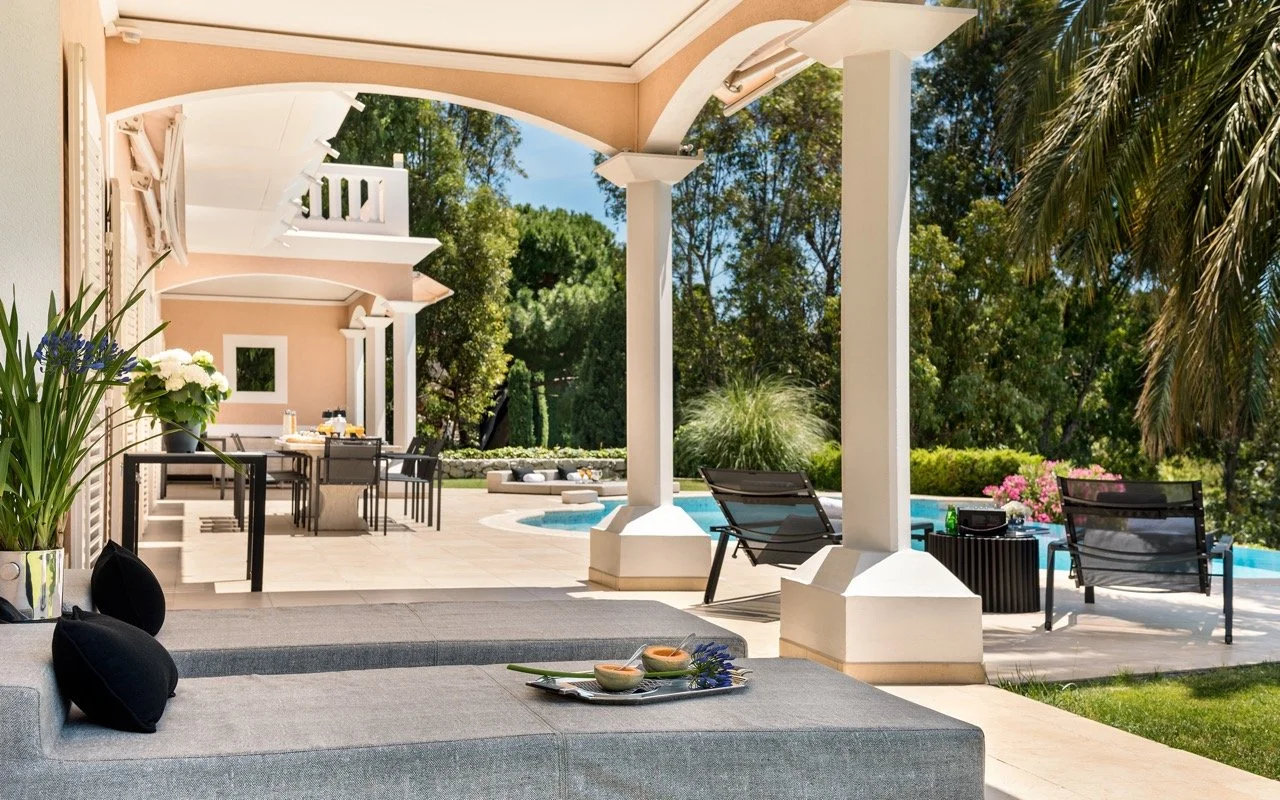
Over the years, the villa has hosted private art exhibitions, transforming its salons and terraces into intimate exhibition spaces. The combination is genuinely unusual on the Riviera: a six-bedroom luxury estate that can also function — by arrangement — as a venue for private viewings, collector dinners, artist talks, gallery presentations and cultural gatherings. For galleries planning a Riviera season, for collectors hosting a small group, or simply for guests who would like to inhabit a property where art is part of the atmosphere rather than the marketing, the villa offers a setting that very few addresses on the Côte d'Azur can match.
Enquiries from galleries, curators, art foundations and private collectors are welcomed by the villa's concierge team.
V · Frequently Asked
Art on the Côte d'Azur — FAQ
Why is the Côte d'Azur famous for art?
The Riviera attracted Europe's greatest modern artists for over a century — drawn by its exceptional Mediterranean light, mild year-round climate, dramatic coastal landscapes, and the creative community that grew up around Cagnes-sur-Mer, Antibes, Saint-Paul-de-Vence and Menton from the 1880s onwards. Picasso, Chagall, Matisse, Renoir, Léger, Cocteau and Yves Klein all lived or worked extensively along this stretch of coast, and their legacy survives in one of Europe's densest concentrations of world-class museums and artist homes.
What are the best art museums on the French Riviera?
The eight essential visits are the Musée National Marc Chagall (Nice), the Fondation Maeght (Saint-Paul-de-Vence), the Chapelle du Rosaire by Matisse (Vence), the Musée Matisse (Nice), the Musée National Fernand Léger (Biot), the Musée National Picasso (Vallauris), the Musée Renoir (Cagnes-sur-Mer), MAMAC (Nice) and the Musée Jean Cocteau — Le Bastion (Menton).
What is the Fondation Maeght famous for?
The Fondation Maeght in Saint-Paul-de-Vence is widely regarded as Europe's finest private modern-art foundation. Created in 1964 by gallerists Aimé and Marguerite Maeght with Joan Miró, Alberto Giacometti, Georges Braque, Alexander Calder, Marc Chagall and Fernand Léger, it integrates Josep Lluís Sert's modernist architecture with works by those artists across courtyards, sculpture gardens, terraces and indoor galleries. Plan at least three hours.
Which museum is best for families with children?
The Musée National Fernand Léger in Biot is the most family-friendly of the great Riviera museums — its bold colours and geometric forms are immediately accessible to children, and the museum runs regular creative workshops for parents and children together.
Is the Jean Cocteau Museum in Menton open?
Yes — but at one of two buildings. The original 1966 Musée Jean Cocteau — Le Bastion on the seafront is open daily except Tuesdays (€5 entry) and hosts rotating exhibitions of the Severin Wunderman collection. The larger Musée Jean Cocteau designed by Rudy Ricciotti next door has been closed since Storm Adrian flooded it in October 2018, and is not expected to reopen before 2030.
Where did Picasso live on the Côte d'Azur?
Picasso spent nearly three decades on the Riviera, living and working in Antibes, Vallauris, Cannes and Mougins. The Musée Picasso in Vallauris (his War and Peace chapel) and the Musée Picasso in Antibes (his 1946 studio at the Château Grimaldi) are the two essential visits for understanding his Riviera period.
Can I visit several Riviera art museums in one day?
Yes — one of the great advantages of the Côte d'Azur is the short distances between cultural sites. A typical day combines two to three museums, such as Chagall + Matisse + MAMAC in Nice, or the Chapelle du Rosaire + Fondation Maeght in Vence/Saint-Paul-de-Vence. See the three-day itinerary above.
When is the best time of year to visit Riviera museums?
Riviera museums are open year-round. Spring (April–June) and autumn (September–November) offer the best combination of mild temperatures, beautiful light and smaller crowds. Many museums close on Tuesdays; the Chapelle du Rosaire also closes Sundays.
Can Villa Monaco host private art exhibitions?
Yes. Villa Monaco offers an exceptional setting for private art exhibitions, gallery presentations, collector receptions, artist talks and cultural gatherings. Its generous interiors, sea-view terraces, abundant natural light and refined architecture create an environment particularly well-suited to showcasing modern and contemporary works. Enquiries are welcomed via the concierge team.
What is the best luxury villa for art lovers near Monaco?
Villa Monaco, in Cap-d'Ail just three minutes from the Monaco border, is uniquely positioned for art-focused holidays: owned by an art collector with a history of hosting private exhibitions, within an hour of every major Côte d'Azur museum, and designed with the light, space and proportions that art naturally requires.